If you want a working filter design fast, Texas Instruments has the document for you.
http://focus.ti.com/lit/an/sloa093/sloa093.pdf
High pass, low pass, band pass, band reject. Circuits for dual and single supply designs too.
If you want a working filter design fast, Texas Instruments has the document for you.
http://focus.ti.com/lit/an/sloa093/sloa093.pdf
High pass, low pass, band pass, band reject. Circuits for dual and single supply designs too.
ladyada maintains a wiki page of parts called Partfinder, so I thought I might just use the name because I lack creativity. Hope she doesn’t mind.
I bought a couple of the rotary encoders that SparkFun carries through a local online store here called sgbotic.com for S$4.95 and I was wondering whether there were any other similar alternatives. I did a search on my favourite component distributor, now called element14, and it turns out there is a cheaper alternative! So I thought I’d share it here.
Here’s a nice video about how an oscilloscope (or generally a regular) cathode ray tube works.
Correction: The device is actually an iMON Multi-Median (MM), which includes an IR receiver and a remote control.
My friend recently passed me a brand new unopened SoundGraph iMON IR receiver device. Here’s how it looks like:

As you can see from the box, it supports up till Windows XP. If you’re thinking how the terms “Windows XP” and “brand new unopened” go together, it’s because he’s kept it for 4 years.
The receiver is quite interesting, it’s a transparent orb with the usual IR filter at the front. I can’t help but notice the PCB looks like it only has a few components in it. And you know what Dave from the EEVBlog always says: “don’t turn it on, take it apart!”
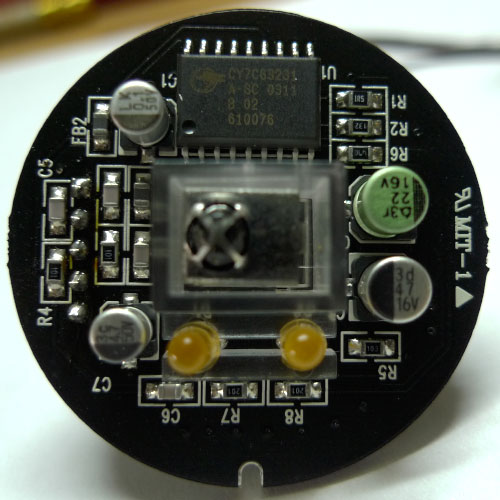
Unsurprisingly, it uses a Cypress Semiconductor CY7C63221A for USB communication. Cypress Semiconductor is quite well-known for manufacturing single ICs which combine a USB transceiver and microcontroller to lower component count. You can find their chips in some keyboards and maybe mice as well. The CY7C63221A is already obsolete, but luckily Octopart still has a cached copy of the datasheet.
In the middle is the IR receiver, which is a 3-terminal device that (I assume) decodes 36-38 kHz modulated IR signals and outputs the de-modulated signal.
So it looks like I won’t be able to tell how it communicates just by looking at the chip, but at least it’s supported by LIRC. I’ll probably hook it up and try it out when I have time.
This was my first time trying to really repair something, and I’m forced to do it. It’s an Akira DVD player that is used as an audio CD player.
When I received the unit, I plugged it in and turned it on. Hmmm… nothing happened, so I opened it up to see what’s wrong. Apparently it has bulged capacitors, which is quite a common problem.
I guess the main cause was the 100μF smoothing capacitor that’s placed directly after the rectifier bridge. You can see the rectifier chip to the right of the large capacitor.
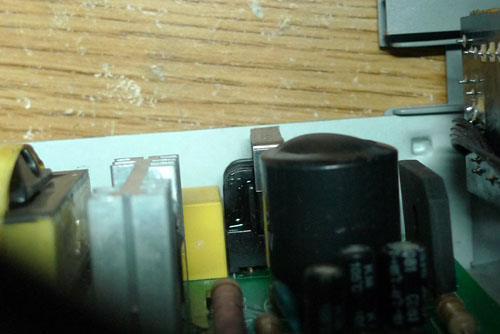
There were also some that were around the board that may not be related, but I just replaced them all at one go anyways.

I tried to remove the solder using a spring-powered desoldering pump but I couldn’t remove the solder from some holes. Instead I just pushed the component lead through while heating up the solder, which is a really bad way to solder but hey, any more heat I apply could just damage the PCB traces.
After replacing the capacitors, the unit managed to power up. However, the LED that was powering the LCD screen backlight was flickering. I found that odd actually, but I really didn’t want to investigate it. Also, the springy audio connectors for the speaker wires at the back were also broken, but I have no idea where to find a replacement for it.
The amount of work required? The capacitors totaled to S$6, but I made 2 trips to get the components (because I missed out some capacitors), and I spent an evening replacing the capacitors. If I had to spend more time figuring out the problems, it would have been longer.
I think such repairs are really not worth it because you have to spend time understanding the circuit before you can really fix the problem (in the case of the LED backlight). If it was something antique and worth fixing it wouldn’t have been so bad, but this is just some cheap off-the-shelf audio system you can buy easily.
Oh well, at least it’s done and I can get it off my hands.
 irq5.io